The view from the top by Leo Kirkbride
I don’t do it. I wish I did. Perhaps I’ll pick up the habit.
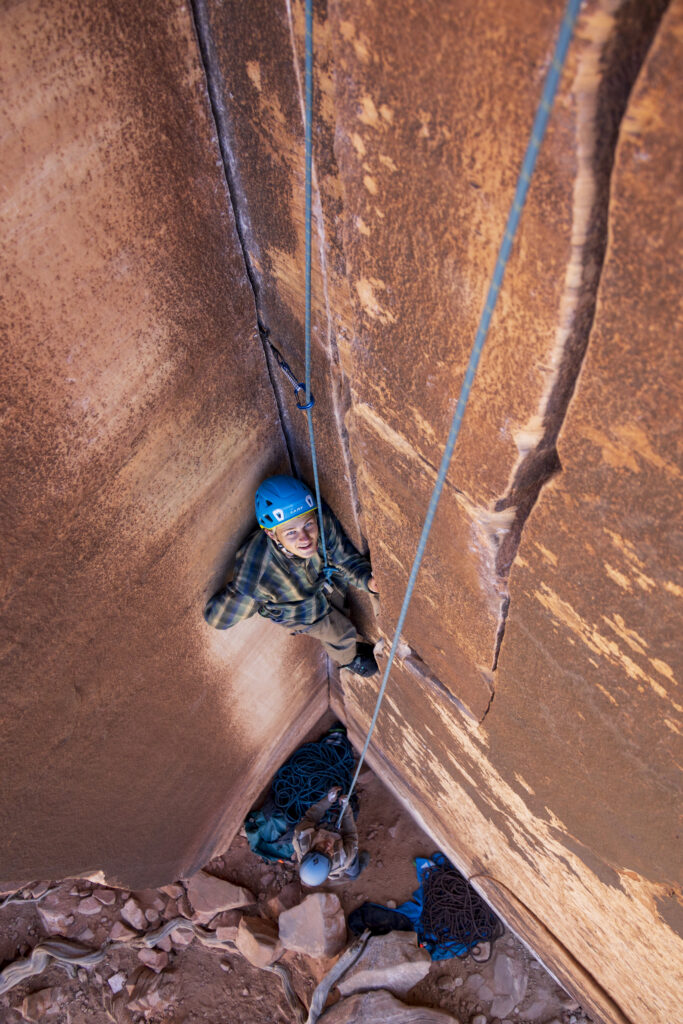
Every time she finishes a climb, before she tells her belayer to lower, she turns around. She pushes away from the wall, lets the wind pass her by and the sun press against her face.
For just a moment, she takes in the view, whatever that may be, and takes a breath.
Then, she calls, “Okay, lower!” and soon enough, her feet are back on the ground and she can carry on with her day.
When you’re climbing out here — Rifle, Indian Creek, Moab, wherever — it’s easy to get lost in the thrill of it all. Your climbing shoes pressing against your overworked toes, the skin of your fingers rubbing away in the rock, the constant clinking of the gear, the list goes on. The days slowly begin to blend into one unforgettable day.
It’s really quite easy to forget where you are.
But, I think it’s vital to stop and look around every once in a while.
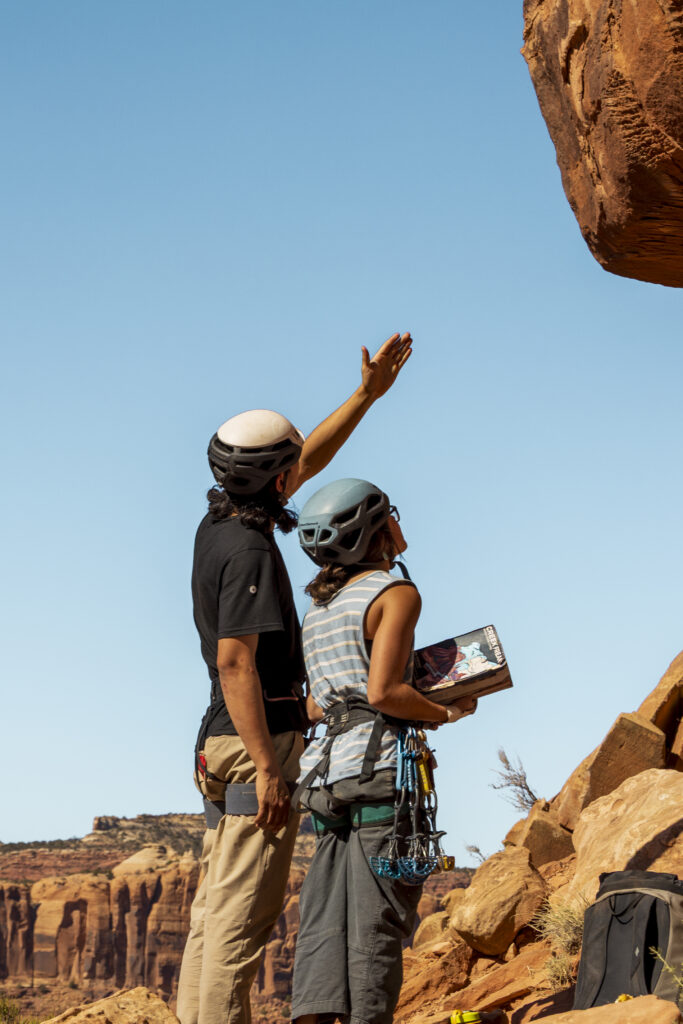
For me, once I finish a climb, I look down to my belayer to see where I’ve come from. And sometimes, the land upon which I’m visiting extends its hand to tell me that I’m experiencing something bigger than myself.
After that moment is over, I call out to my belayer, “Okay, lower!”
The moment is gone, momentarily lost to some faraway part of my brain. But, maybe next time I get to the anchor of my climb, I’ll push away from the wall, let the wind pass me by, and the sun press against my face.
I’ll take in the view, whatever view it’ll be, and take a breath.
The gift of rain by Nat Bunnell
“A gift comes to you through no action of your own, free, having moved toward you without your beckoning. It is not a reward; you cannot earn it, or call it to you, or even deserve it. And yet it appears. Your only role is to be open-eyed and present.” (Robin Wall Kimmerer, Braiding Sweetgrass)
As the rain finally began to subside, so did our group’s conversation. Stiff and restless from spending the last hour crammed among my trekmates under a cave, I eagerly collected my belongings and made my way toward a patch of open slickrock, where I could stretch my legs at last. I turned back to face the wall and bent forward, letting my head hang over my legs. Before the canyons section, my vision during this stretch had aligned neatly with the middle of my shins, but after several days of relying on my hamstrings to haul both me and my hundred-liter pack from riverbeds to mesas, the fatigue had caught up to me. The furthest I could see now was my lower kneecaps. I took a few deep breaths in hopes of growing accustomed to the strain, but it was no use. Wincing, I propelled my hips forward and straightened to standing.
“Whoa, look at that!” a voice called from behind me. “A rainbow!”
I unsquinted my eyes. And there it was—or rather, there they were: two of ‘em. I rubbed my eyelids, half-assuming I’d stood up too hastily and incited some sort of temporary double vision. Still, the universe’s magic met me. The rainbows stood side by side, the right one just a shade fainter than the left.
“Guys!” I exclaimed. “It’s a double! That brings good luck!”
My enthusiasm garnered no response. I glanced around at my companions, but their faces were fixed in silent awe. Why consider whatever luck a double rainbow might promise for the future, when here, in this very moment, standing before its brilliance, we were already so lucky?
In many ways, the fourteen students on this year’s HMI Gap Semester have brought this experience upon ourselves. We wrote and submitted our applications, packed our bags, and arrived at various airports on time for our flights to Denver. And at times, our joys feel genuinely earned—like cheese quesadillas for dinner after a hike that began at 8:30 a.m. and didn’t end until 6:15 p.m. However, as my journey through these eighty days continues, I’m realizing more and more how much of it is, in truth, a gift: something we neither requested nor particularly deserve, and yet it stands before us, asking only that we receive it wholeheartedly.
Not every gift looks like a rainbow. Some are more subtle: a ten-minute hiking break on a patch of sunny ground after a long, frigid morning; warm, clean, perfectly-pressured water from the showers at the Moab Rec Center; a shady cottonwood tree, perfect for four-hour solo time; animal tracks in a stretch of canyon that’s particularly tricky to navigate; a gust of wind that cools your forehead just when you need it most. Though we all signed up to be here, none of these small joys we’ve received came to us solely through actions of our own. We can thank the sun for shining, the river for flowing, the wind and rock for working together to form the landscapes we move through, and the wildlife for, well, living.
As the days begin to dwindle, albeit slowly, I hope to soak them in with eyes open to what arrives freely, unsolicited. To remark each gift, whether grand and undeniable or quiet and fleeting, is to move through each place with wonder instead of want, with gratitude instead of triumph. This experience, with all its splendid fruits, is not something I’ve earned but something I’ve been entrusted with. And if my only task is simply to be present as it unfolds, that feels—if you can bear a little more sappiness (surely you can, as you’ve made it this far)—like the most worthy pursuit there is.
Fun in Mud by Henry Snow
One of the most memorable moments during my time in Utah and our 17-day expedition was on the second-to-last day of our trip. We had gotten a day ahead of schedule after a flash flood tore through the canyon beside our campsite just before we set out for the second half of our journey. The flood had blocked the route to our first campsite, forcing us to adjust our plan and split what was supposed to be a six-mile trek towards the end of the trip.
Before departing from Nook Canyon, a campsite nestled between two intersecting canyons, everyone was confident the walk would be easy. It was only two and a half miles compared to the five to seven miles we had grown used to hiking each day. We had also just taken a layover day, giving us time to rest, wash clothes, and recharge. Our expectations were high, and when we began our descent back down the same canyon where we had witnessed the flash flood just days earlier, we were met with a rare and beautiful sight: clear water running through the canyon bed. Up until then, every stream we’d encountered had been dirty with clay and silt. The clean water felt like a reward.
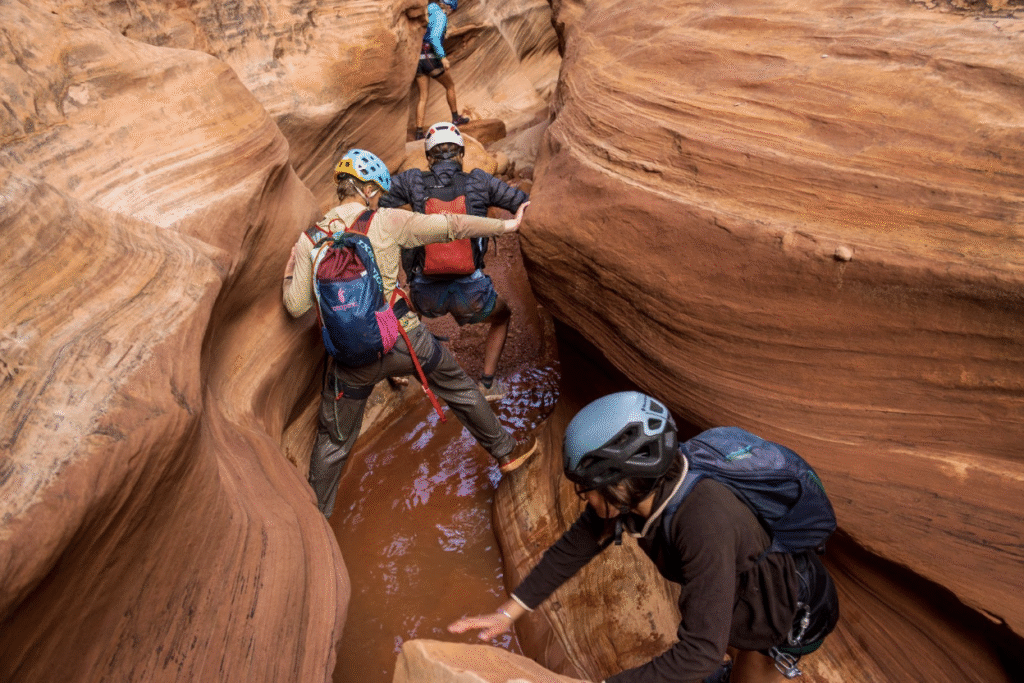
But our optimism didn’t last long. A few miles in, we reached a section of the canyon that required us to drop down a level. This level looked like a narrow boulder graveyard, with huge puddles surrounding each one. To get through, we had no choice but to walk directly into the cold water. As we pushed forward, we noticed that the mud beneath us had become soft and unstable, sinking under our weight.
I was leading that day, which meant there was no one in front of me to test the ground. I reached this inconspicuous section, with a bunch of stones lining the dirt. After a few steps, I began sinking. The mud swallowed my boots, then crept up to my knees. For a moment, panic set in. It felt like quicksand, and I could feel the tug of the earth pulling me down as I tried to lift a foot free.
I was eventually able to get both of my feet out of the mud and crawl over to a nearby rock. While it took me a while to collect myself, I looked around and noticed that everyone else in my group was laughing and having a good time, despite being soaking wet and covered in mud. Later, that moment of fear turned into one of the highlights and stories to tell from the trip. While it wasn’t fun in the moment, I realized that the most uncomfortable and unpredictable moments turned out to be my most favored memories.
Preserving the land for all users by Ella Adams
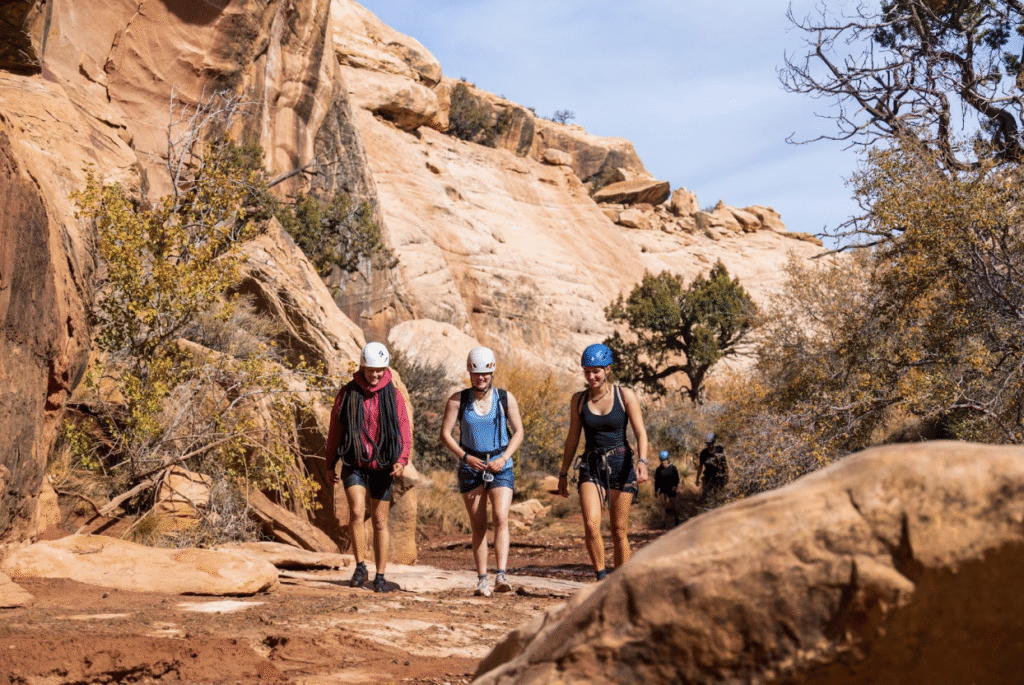
The heat settled into the red sandstone, and a quiet stillness filled the air around Gravel Canyon. Our group had run Cowboy Canyon the day before, and we were camped along the rim of Gravel for our last night in the field.
As part of our Environmental Studies curriculum, we gathered in a circle to talk about land use and management in Bears Ears—how people use, care for, and share public lands. The conversation flowed easily as we explored the balance between recreation, conservation, and the livelihoods of those who depend on the land—ranchers, grazers, miners, and others whose work is tied to these landscapes.
Just as we were wrapping up our discussion, two cowboys appeared on horseback, driving a small herd of steers along the canyon rim, their dogs trotting behind. The timing couldn’t have been better; it was a living example of how the land supports so many different uses and traditions, some of which people have been practicing for generations and generations.
While sitting there, recreating on the land, it struck me how connected everything is. My extended family are cowboys and ranchers, and it was especially meaningful to see that side of land use up close, making me feel more connected to both my ancestors and the land. I was reminded that these lands are shared spaces, full of stories, work, and ways of life that all intersect in beautiful ways. Watching the cowboys ride by, I thought about how the same trails that carry backpackers and students like us have also carried cattle, horses, and people working the land for centuries. Every person who passes through leaves a mark—whether it’s a footstep, a hoofprint, or a new idea about what stewardship means.
Caring for public lands isn’t just about protecting them from use, but about understanding the many ways people connect to them. These places hold both history and possibility, and our challenge is to find ways to honor all of those connections while ensuring that future generations can experience them too. Protecting these lands, then, becomes not just an act of conservation, but an act of community and continuity.